Rachel Dolezal Says Black Identity Is Not A Costume
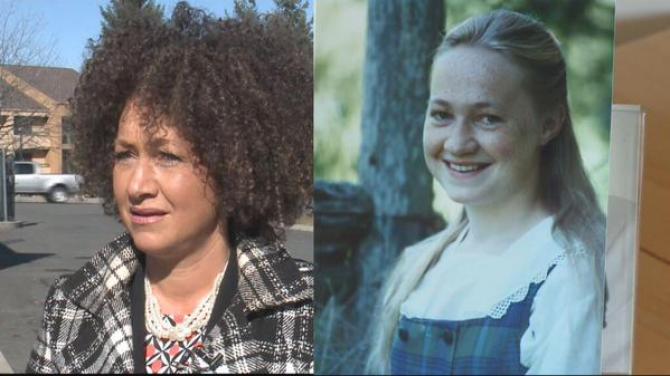
Source: @KREMTaylor / NewsOne/Twitter
In mid-June when Rachel Dolezal was asked on camera, “Are you African-American?” she was left speechless, hesitant and caught off guard. After claiming to misunderstand what she had been asked, she deflected a clear response. It was a question that wouldn’t normally stupefy a person, unless of course the answer would reveal a web of lies. Her name was a trending Twitter hashtag for days and brought on a series of tweets and memes that would start the dialogue for the rest of us to perhaps make some sense of Dolezal’s identity maze. Now, she continues to stand firm that her Black identity is not an act.
Dolezal’s audacity to claim Black womanhood was the most shocking, given that she had fabricated her genealogy, tanned her skin and even became an “expert” in Black hairstyles to keep the jig going. This was different than just another cultural appropriation instance — Dolezal hadn’t toyed with lip, buttocks and hip enhancements to make her White look exotic. She had taken on the supposed lifestyle and aesthetic of a Black woman and her position as the President of the NAACP chapter in Spokane, Washington to advocate for Black people.
Dolezal addresses her controversy in an article in Vanity Fair, “It’s not a costume,” she says. “I don’t know spiritually and metaphysically how this goes, but I do know that from my earliest memories I have awareness and connection with the black experience, and that’s never left me. It’s not something that I can put on and take off anymore. Like I said, I’ve had my years of confusion and wondering who I really [was] and why and how do I live my life and make sense of it all, but I’m not confused about that any longer. I think the world might be—but I’m not.”
It’s not unfathomable that Dolezal could have a genuine connection to Black heritage, her Whiteness doesn’t discredit her interest. What is puzzling is her denial of her biological parents, a statement from Dolezal’s former student at Eastern Washington University who felt hostility from her teacher about the validity of her own Hispanic heritage, and Dolezal’s attempt as a graduate student at Howard University to file a lawsuit against the institution for experiencing alleged discrimination because she was White. All of these elements are conflicting and dismantle her narrative that she had no choice but to take her attraction to Blackness and attempt to adopt the experiences of a race that she was not born into. Her dissensions mirror ingenuity in her motives.
But, Dolezal’s taken time to craft this image and her spent years examining Black history and culture have provided her with the perfect literary and sociological tools to portray her life as a Black woman.
Via Vanity Fair:
“It’s taken my entire life to negotiate how to identify, and I’ve done a lot of research and a lot of studying,” she says. “I could have a long conversation, an academic conversation about that. I don’t know. I just feel like I didn’t mislead anybody; I didn’t deceive anybody. If people feel misled or deceived, then sorry that they feel that way, but I believe that’s more due to their definition and construct of race in their own minds than it is to my integrity or honesty, because I wouldn’t say I’m African American, but I would say I’m black, and there’s a difference in those terms.”
Dolezal’s response shows that she’s out of touch, claiming that this is something (which appears to some as Blackface) that she can no longer remove. She has claimed a race that she was not born into and that is misleading.
Spokane’s new NAACP President, Naima Quarles-Burnley, said to Spokesman-Review, “I feel that people of all races can be allies and advocates, but you can’t portray that you have lived the experience of a particular race that you are not apart of.”
Dolezal expressed that she felt some “coldness” from Burnley and that the distance from the chapter has been difficult for her. Her life has been turned upside down since the truth was exposed. She has been let go from her positions at both the NAACP and Eastern Washington University, burned numerous bridges with friends and abandoned her biological family, but there’s a loss that goes unacknowledged by Dolezal. The lack of regard for the Black women whose spaces she has occupied shows no concern for the expenses of her gains. Her eagerness has illustrated an ulterior need to satisfy a selfish identity clash that serves her own personal advancements. Dolezal is unapologetic about the shaky truth that she now has no choice to live in, completely missing the fact that there is no alliance in taking what does not belong to you.
Still, Dolezal insists that her Black identity makes sense, that it was always inherently factual and that she is indeed a Black woman. As a result of her fall from false grace, she told Vanity Fair that she is now maintaining a steady income with one of her takeaways from her devout studies of Black culture by doing braids and weaves.
SOURCE: Vanity Fair, Spokesman-Review | PHOTO CREDIT: Getty
Rachel Dolezal Says Black Identity Is Not A Costume was originally published on ionenewsone.staging.go.ione.nyc


